About
Fix The Mix is written and maintained by Mónica Andrade, under Artek Futura.
The person behind it
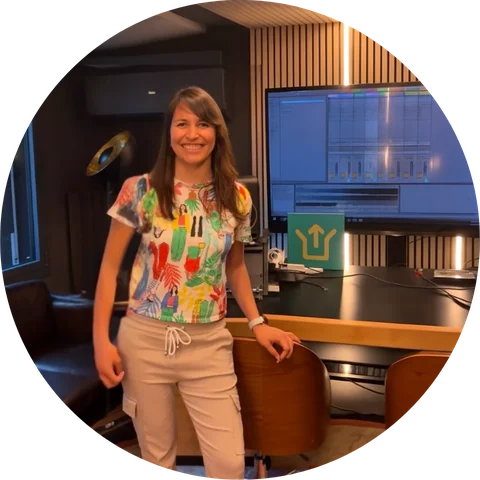
My name is Mónica Andrade. I'm an artist, producer and audio engineer, a graduate of Berklee College of Music, and I release my own music as Monár.
Besides producing, I teach music production and the use of AI in creative work. Those two things — making records and teaching people to make them — are what turned into this site: I've spent years watching where beginners get stuck, and it's almost never where they think.
Her music and profiles: monarmusic.com · Instagram (@monarmusic_)
I write every guide on this site myself. They aren't summaries of other people's articles: they come out of actually mixing and producing, which is why they take a side when there's a side to take instead of listing every possible option.
Why Fix The Mix exists
Mixing is learned with your ears, and ears are trained by repetition: recognising a zone of the spectrum, noticing how much a compressor is working, hearing that something sits two decibels above where it should. None of that is learned by reading — and yet nearly all the material out there is written to be read.
Fix The Mix is an attempt to give that half the format it deserves: short exercises, with immediate feedback, on real audio. The tools and minigames are for practising; the guides are for understanding what you're practising. Neither half works on its own.
How the guides are made
- Each one answers something people actually ask, not a keyword with search volume.
- They carry a visible date and go up gradually. Right now there are 19.
- They get corrected when I change my mind or when someone points out a mistake. If you spot one, write to me.
- They link to the tool or minigame where that specific thing is practised, because reading about EQ and doing EQ are two different skills.
A good place to start is the guide index.
How I decide what to write about
From the questions that arrive by email and from what I watch people get wrong when I teach, not from a keyword tool. There are high-volume topics I haven't written about because I have nothing of my own to say, and there are guides — phase, monitoring — that almost nobody searches for and that solve problems which ruin whole mixes.
When a guide claims something debatable, I say so. Mixing is full of decisions where two schools are both defensible, and a text that lists them all without committing helps nobody finish a song. I'd rather explain why I pick one and when I'd pick the other.
What costs money and what doesn't
The guides are free, all of them, with no sign-up and no email in exchange. So are most of the exercises: the entry levels of every game play without an account. What costs money is the advanced content — the upper tiers of each minigame — and removing the ads.
The ads exist because the site has server and audio costs that somebody pays, and I'd rather that be whoever doesn't want to subscribe than close off the content. There are no ads over a game in progress or inside the application screens: they only sit alongside pages with text.
About the music you hear here
The exercises that work on complete songs use music by real independent artists, with their stems, and every play generates royalties for them. We could have generated cheaper, cleaner practice material, but that material doesn't teach: it lacks the conflicts that make mixing hard. You can see who they are in the artists section.
Contact and company
For questions, corrections, proposals or anything else about the site: hello@artekfutura.com. I read every email.
Company behind the site
Artek Futura (Futurawave SRL) · NIF B67881953
Av. Mare Nostrum 7, 46120 Alboraya, Valencia, España
Ownership and data handling: Privacy Policy · Terms and Conditions.